
A Practical Guide to Protecting Trust and Retention
By World Class Contact Centers
Every business receives customer complaints. What separates strong brands from struggling ones is how those complaints are handled.
Customers do not expect perfection. They expect responsiveness, accountability, and resolution. When something goes wrong, the way you respond becomes more memorable than the issue itself.
At World Class Contact Centers, we view complaint management as a core operational capability. When handled with structure and empathy, complaints become opportunities to strengthen loyalty and improve performance.
This guide outlines a practical framework for handling customer complaints effectively, from frontline conversations to operational strategy.
Why Customer Complaints Matter
A complaint is feedback delivered with urgency. It highlights a gap between expectation and experience.
Customers who speak up are still engaged. They are giving your organization a chance to respond. Businesses that treat complaints as insights instead of disruptions gain valuable information about service gaps, communication breakdowns, and operational weaknesses.
Handled well, complaints can:
- Increase customer retention
- Strengthen brand trust
- Improve internal processes
- Reduce repeat contacts
- Enhance long-term customer value
Ignoring or mishandling complaints produces the opposite effect. It leads to churn, public criticism, and higher service costs.
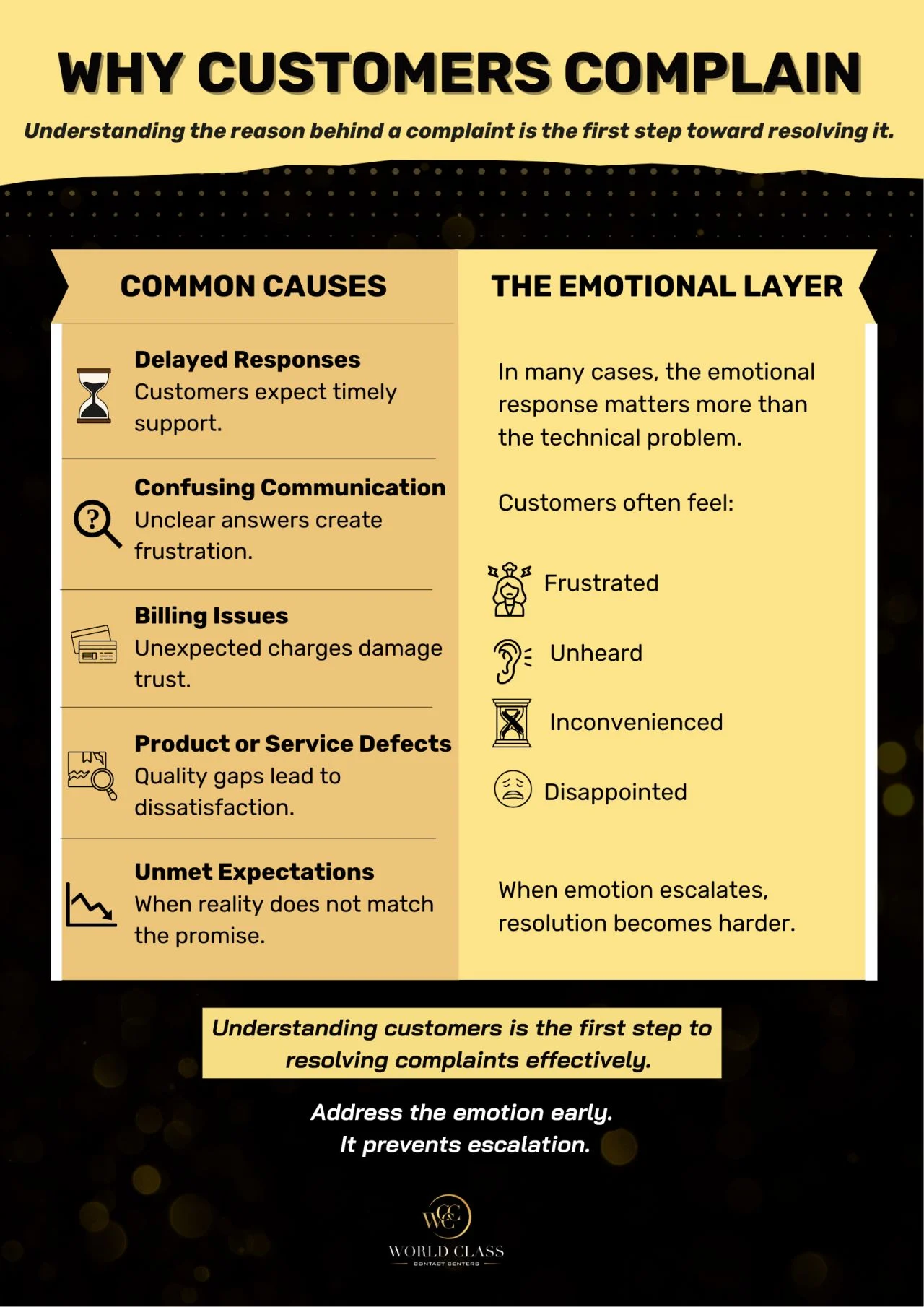
Why Customers Complain
Understanding the reason behind a complaint is the first step toward resolving it.
Common causes include:
- Delayed responses
- Confusing communication
- Billing issues
- Product or service defects
- Unmet expectations
In many cases, the emotional response matters more than the technical problem. Customers often feel frustrated, unheard, or inconvenienced. Addressing the emotional layer early helps prevent escalation.
Effective complaint handling begins with listening.

The Cost of Poor Complaint Handling
Weak complaint management has measurable consequences.
Customer churn increases when problems are unresolved. Negative reviews spread quickly, especially online. Operational costs rise when customers contact support repeatedly about the same issue. Employee morale declines when agents face frequent escalations without proper authority or training.
Complaint handling should not be reactive. It requires a structured system that supports both customers and employees.
The WCCC Framework: A Structured Approach to Handling Complaints
At WCCC, we train support teams to follow a consistent resolution process. This ensures clarity while leaving room for human connection.
Step 1: Listen Actively and Without Interruption
Customers need to feel heard before they are ready to accept solutions.
Best practices:
- Allow the customer to fully explain
- Avoid interrupting
- Take notes
- Maintain a calm tone
Active listening reduces escalation and prevents misunderstanding.
Step 2: Acknowledge the Experience
Acknowledgment does not require admission of fault. It requires recognition.
Examples:
- “I understand how frustrating that must be.”
- “I can see why that would be concerning.”
Validation builds trust.
Step 3: Apologize Professionally
A sincere apology communicates accountability and respect.
It should be:
- Clear
- Calm
- Specific
A well-delivered apology often lowers emotional intensity significantly.
Step 4: Clarify and Confirm the Issue
Before offering solutions, ensure alignment.
- Ask clarifying questions
- Restate the issue
- Confirm understanding
This prevents solving the wrong problem.
Step 5: Present a Clear and Realistic Solution
Customers value transparency more than perfection.
Provide:
- Concrete next steps
- Clear timelines
- Options when possible
- Escalation pathway if needed
Avoid vague responses. Clarity builds confidence.
Step 6: Act Quickly
Speed matters—especially during dissatisfaction.
When possible:
- Resolve during first contact
- Minimize transfers
- Use smart routing to avoid repetition
Efficiency reinforces competence.
Step 7: Follow Up
Follow-up demonstrates ownership beyond the immediate interaction.
Effective follow-up:
- Confirms resolution
- Rebuilds confidence
- Encourages feedback
- Reduces repeat complaints
This structure balances efficiency with empathy. It reduces friction and improves consistency across teams.
Managing Difficult or Emotional Situations
Some complaints arrive with strong emotion. When this happens, composure becomes critical.
Support professionals should:
- Maintain a calm tone
- Avoid defensive language
- Focus on solutions
- Set respectful boundaries if needed
De-escalation is a skill that can be trained. At WCCC, we prioritize emotional intelligence as much as technical knowledge.
When agents feel supported and empowered, they respond with greater confidence.
Designing a Complaint-Ready Operation
Handling complaints effectively requires more than good communication skills. It requires operational design.
Key components include:
Clear Escalation Paths
Agents should know when and how to escalate issues. Defined tiers prevent confusion and delays.
Frontline Authority
Empowering agents to resolve common problems reduces transfers and improves customer satisfaction.
Technology That Supports Resolution
CRM systems, ticket visibility, and smart routing reduce repetition and provide context. Technology should simplify the experience, not complicate it.
Ongoing Training
Regular refreshers in communication, product knowledge, and de-escalation keep teams prepared.
Complaint management is strongest when systems and people work together.
Turning Complaints Into Loyalty
Customers often remember how an issue was resolved more than the issue itself.
A thoughtful recovery can restore confidence and strengthen the relationship. Customers who experience respectful and effective resolution frequently become long-term advocates.
Complaint handling is one of the clearest demonstrations of brand values in action.
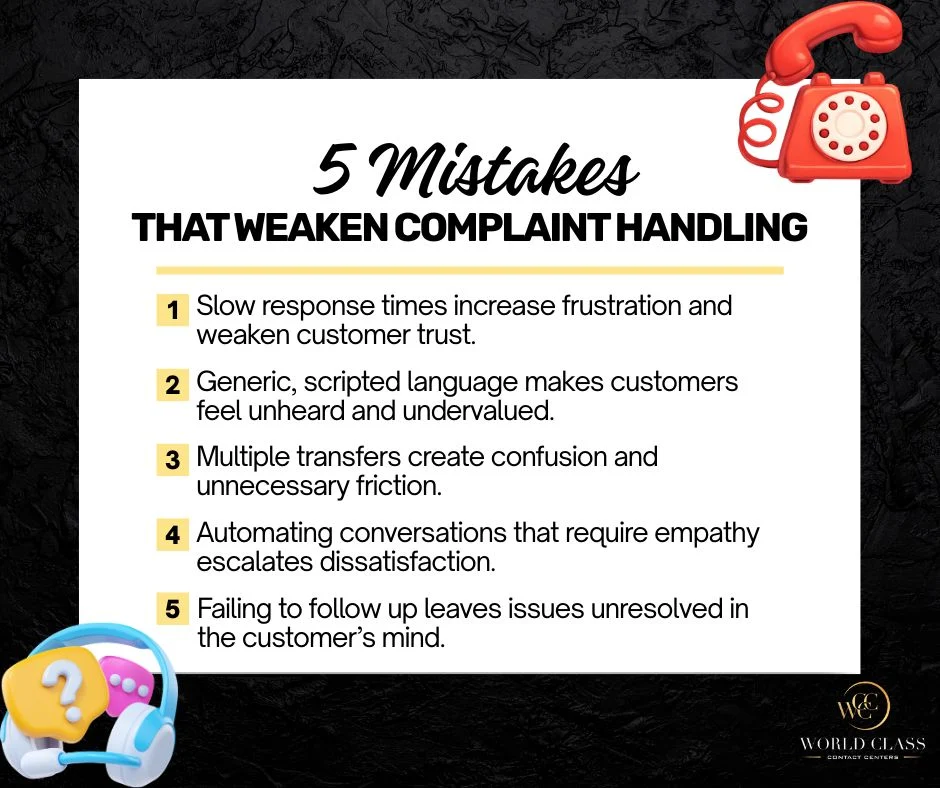
Common Mistakes to Avoid
Even experienced teams make avoidable errors:
- Delaying responses
- Providing scripted, impersonal replies
- Transferring customers repeatedly
- Over-automating sensitive situations
- Failing to close the loop
Customers should never feel like they are navigating internal processes. The experience should feel guided and responsive.
Building a Culture That Learns From Complaints
The most resilient organizations analyze complaints regularly. They identify patterns, refine processes, and improve training.
At World Class Contact Centers, we treat complaint data as a strategic asset. Root cause analysis and feedback loops allow continuous improvement across operations.
Complaint management is not just a frontline responsibility. It reflects leadership, culture, and long-term commitment to customer experience.
Final Thoughts
Complaints are not interruptions. They are opportunities to demonstrate reliability when it matters most.
Handling customer complaints effectively requires structure, empathy, speed, and accountability. When these elements work together, resolution strengthens relationships instead of damaging them.
Organizations that invest in complaint-ready systems protect more than reputation. They protect trust.
If your team is evaluating its complaint management process, contact World Class Contact Centers to explore how structured support systems can improve resolution quality and customer retention.
👉 Contact us to learn how we can help you turn customer complaints into loyalty-building opportunities.