
In customer support, it’s tempting to think that faster is always better. After all, time is money, and reducing how long it takes your team to resolve each issue should save both. But here’s the truth: if you cut Average Handle Time (AHT) too aggressively, you could also cut into the very thing that makes your brand memorable—the quality of your customer experience.
Today’s customers expect fast responses, but they also want personalized, helpful, and frictionless interactions. If they feel rushed, misunderstood, or forced to call back, satisfaction drops—and so does loyalty.
This blog will help you strike the perfect balance. You’ll learn actionable strategies to reduce AHT while maintaining (or even improving) Customer Satisfaction (CSAT)—so your support team can be both efficient and exceptional.
I. Understanding the Metrics: AHT vs. CSAT
What is Average Handle Time (AHT)?
AHT measures how long it takes for an agent to resolve a customer interaction, from start to finish. It includes:
-
Talk time: The duration of the call or live chat
-
Hold time: How long the customer is placed on hold
-
After-call work (ACW): The time an agent spends updating records, sending follow-ups, or closing the ticket
💡 Why it matters: AHT is a key operational metric. It helps support managers assess agent productivity, forecast staffing needs, and control costs.
Industry benchmark examples:
-
Call centers: 6–8 minutes
-
Live chat: 3–5 minutes
-
Email: 12–24 hours turnaround (measured differently but still relevant)
The goal isn’t to chase the lowest number. It’s to make sure AHT is optimized to reflect both productivity and resolution quality.
What is Customer Satisfaction (CSAT)?
CSAT measures how satisfied a customer is after an interaction. It’s typically captured through a quick survey:
“How satisfied were you with your support experience?”
-
Answers are usually on a 1–5 or 1–10 scale
-
Scores of 4–5 or 8–10 are considered “satisfied”
Why it matters: CSAT is a direct reflection of service quality. High CSAT scores correlate with customer loyalty, brand trust, and reduced churn.
AHT vs. CSAT: The Balancing Act
There’s a common myth that shorter AHT always leads to better service. But if agents focus too much on speed, they might miss the nuances that truly resolve a customer’s problem.
-
Correlation vs. causation: Just because your top-performing agents have low AHT and high CSAT doesn’t mean speed alone caused the satisfaction.
-
The takeaway: Customers value clarity and care, not just a quick call.
At WCCC, we believe both metrics matter—but they must work together. Fast support is great, but if customers leave feeling unheard or unresolved, AHT becomes an empty metric.
II. The Risks of Cutting AHT Too Aggressively
Trying to reduce AHT without a clear strategy can create more problems than it solves:
-
Over-scripted or robotic interactions Agents sound mechanical and disconnected, making customers feel like they’re talking to a bot—not a person.
-
Rushed agents and unresolved issues Pushing for speed can result in misdiagnosis of problems or agents missing important details.
-
Increased callbacks and customer frustration If the issue isn’t resolved properly the first time, customers will call again, increasing overall workload and frustration.
-
Negative impact on employee morale Constant pressure to “handle faster” can create stress, burnout, and even higher attrition rates.
III. Strategies to Reduce AHT Without Compromising Quality
Here’s how to reduce AHT smartly—by improving workflows, training, and the customer experience itself:
✅ A. Optimize Agent Training and Onboarding
-
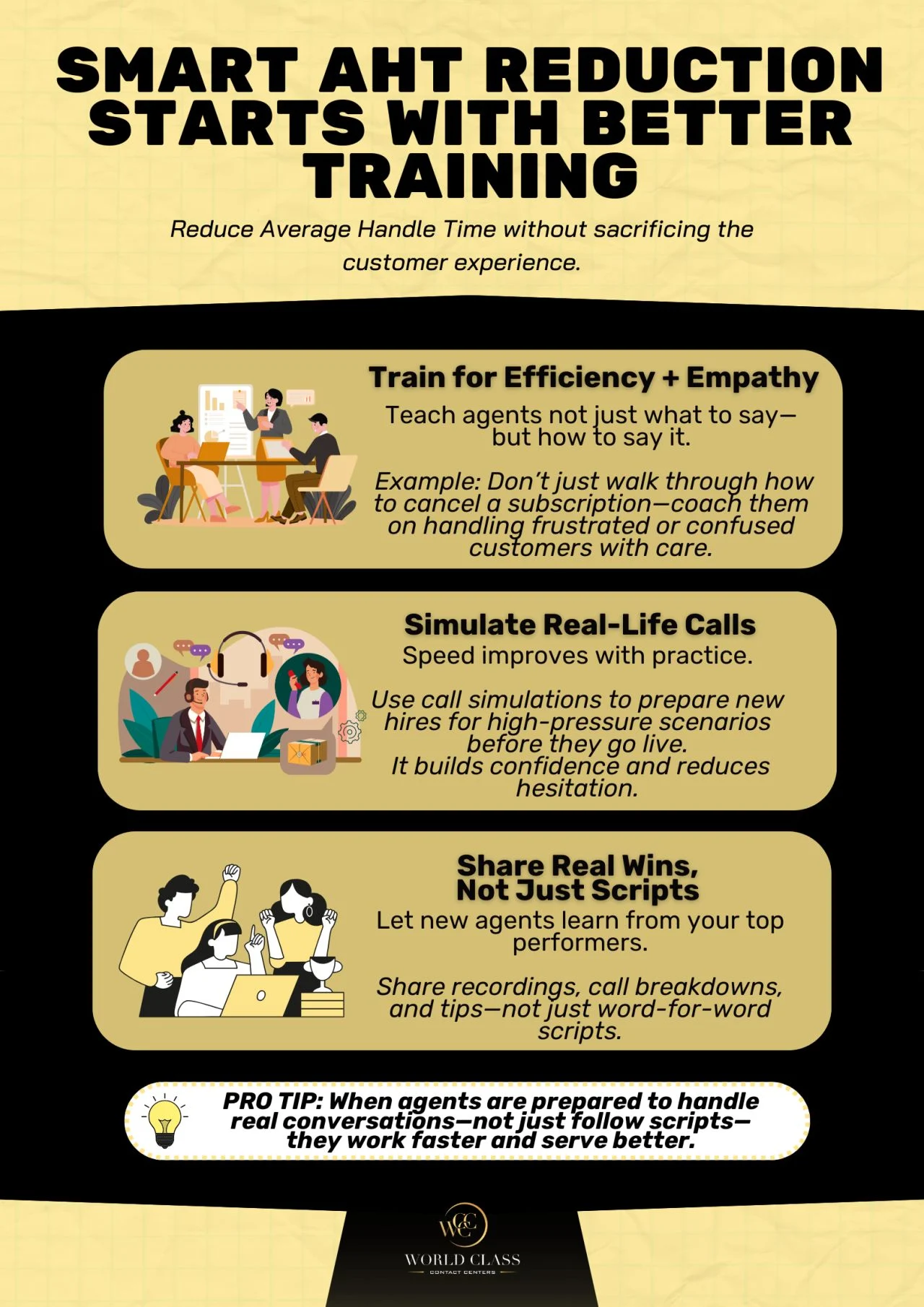
Train agents to balance efficiency and empathy. For example, instead of just explaining how to cancel a subscription, show them how to handle emotionally charged conversations with users who didn’t intend to renew.
-
Use call simulations to help new agents get comfortable under pressure, improving confidence and speed.
-
Share recordings or tips from top-performing agents to promote best practices without rigid scripts.
✅ B. Implement Smart Call Routing
-
Use IVR (Interactive Voice Response) systems or AI-based tools to route customers to the most qualified agents based on skills, language, or account type.
For instance, a company with both enterprise and SMB customers can route high-value accounts to senior agents who specialize in complex issues, reducing transfer time and improving first contact resolution.
✅ C. Use Knowledge Bases and Scripts Wisely
-
Provide agents with a well-organized knowledge base so they don’t waste time searching for solutions. Make it searchable, categorized, and updated regularly.
-
Keep scripts flexible and natural. A script should guide—not restrict—the conversation.
For example, If a customer asks about integrating your app with Zoom, the agent can quickly locate a step-by-step article and send it, while offering to walk them through it live.
✅ D. Automate Repetitive Tasks
-
Use CRM integrations to automatically pull up customer history and notes, saving time on basic verification.
-
Automate follow-up emails, post-call surveys, or even simple resolutions like password resets.
For example: Instead of spending 90 seconds typing a post-call summary, use templated responses that can be triggered with a click—or fully automated based on ticket outcome.
✅ E. Empower Agents to Make Decisions
-
Give agents authority to handle common issues—like offering credits, plan adjustments, or small refunds—without escalating to a supervisor.
For example, If a loyal user is two days late on payment and requests access, allow agents to reactivate their account instantly without needing approval.
✅ F. Encourage Active Listening and First Contact Resolution
-
Encourage agents to let the customer finish explaining before offering solutions.
-
Train them to ask clarifying questions and confirm their understanding before acting.
For example, A user who says “I can’t log in” might actually be locked out due to a company-wide account migration. Listening carefully saves back-and-forth and fixes the issue right the first time.
IV. Enhancing Support with Tech—Not Replacing the Human Element
At WCCC, we use technology to assist, not replace the agent. Our tools:
-
Pre-screen simple issues via chatbot before passing to a live agent
-
Offer real-time prompts to help agents provide faster, more accurate responses
-
Use sentiment analysis to flag negative tones so supervisors can step in proactively.
We combine data, AI, and human intelligence to deliver support that’s fast, friendly, and effective.
V. Monitor, Measure, and Adjust
Success doesn’t come from setting it and forgetting it. Continue to evaluate your support processes by reviewing AHT and CSAT side-by-side. That’s why we:
-
Set realistic performance goals based on issue complexity and customer type.
-
Collect feedback from both customers and agents to identify bottlenecks or areas of confusion.
-
Use A/B testing to trial different workflows, call scripts, or support tools—and measure what actually improves both time and satisfaction.
VI. Real-World Example: Balancing Speed and Service
One of our SaaS partners approached us with a challenge: an Average Handle Time (AHT) of 9 minutes and a declining Customer Satisfaction Score (CSAT). After reviewing call recordings and agent workflows, we discovered that agents were spending too much time searching for information and escalating routine issues unnecessarily.
In just 60 days of working with WCCC, they made strategic improvements:
-
Introduced a centralized, searchable knowledge base
-
Implemented AI-powered call routing to connect customers with the right agents faster
-
Empowered frontline agents with decision-making authority for common, low-risk issues.
The results spoke for themselves: AHT dropped to 6.4 minutes, and CSAT rose to 92%. By focusing on smart optimizations rather than rushing interactions, the company delivered faster service and a better experience for both their customers and their support team.
At WCCC, we believe world-class service is both efficient and human. Reducing AHT doesn’t have to mean compromising your customer experience. With the right training, tools, and support strategy, your team can resolve issues faster and leave your customers feeling heard, valued, and delighted.
Tired of the trade-off between speed and service? At WCCC, we help teams reduce AHT without sacrificing customer satisfaction. 📊 Ready to balance efficiency with empathy? 👉 Book a free consult today. https://worldclasscc.com/contact-us/
#CustomerSupport #CXMatters #SupportOps #ContactCenterTips #AHT #AverageHandleTime #CustomerSatisfaction #CustomerExperience #WCCC